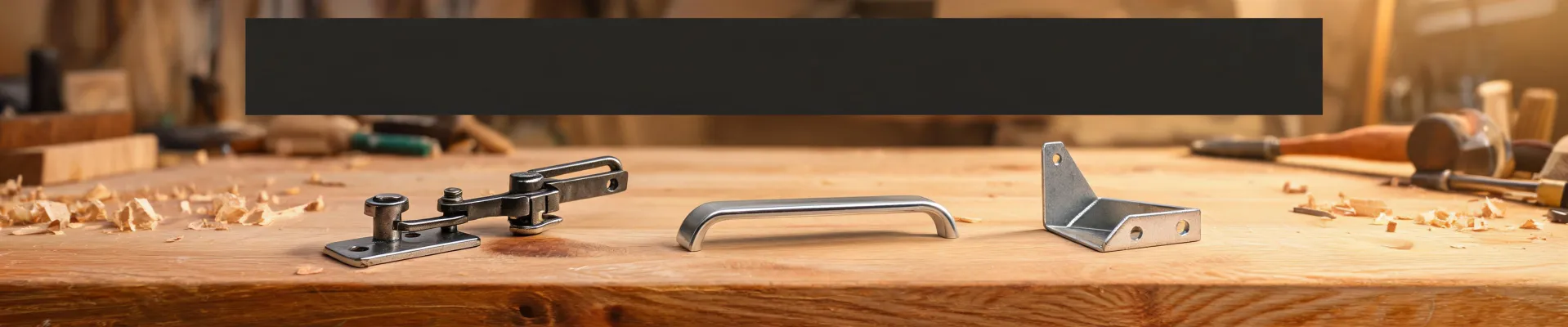
Gate Hardware Sourcing FAQ: Locks, Zinc Plated Hook & Eye, Gas Ball Valves, and Glass Shower Door Hinges
-
How do I pick a gate lock that actually survives outside?
-
Is "zinc plated" the same as "outdoor rated"?
-
How do I tighten a glass shower door hinge without cracking the glass?
-
Can I use a regular ball valve on a gas line?
-
What actually fails on a hook-over feeder?
-
Why do two suppliers' "identical" SKUs behave differently?
-
What's on your pre-order checklist?
I handle gate and door hardware sourcing for a regional distributor. Nine years in. I've personally made — and documented — 14 significant ordering mistakes totaling roughly $41,000. Most of that was on parts that looked identical on the spec sheet and weren't.
These are the questions buyers actually send me, plus a couple I wish they'd asked sooner. Short answers. No fluff.
How do I pick a gate lock that actually survives outside?
Start by splitting the question in two, because most buyers don't. Rekeyability is a keyway feature — the cylinder. Weather exposure and load rating are a hardware feature — the finish and the body. They're sold together maybe half the time.
Plenty of searches land on a "rekeyable gate lock" or a SmartKey-style cylinder, and that's where the confusion starts. On a driveway gate, the cylinder is almost never what fails first. The finish does. Or the strike alignment does, or the bolt starts dragging because the post moved a quarter inch since spring. We swapped 60 gate latches on a commercial property back in 2021 — every failure was finish or alignment, not lockouts.
What I ask suppliers now:
- What's the finish, and what salt-spray hours does it carry?
- Does the latch have adjustable strike or bolt alignment?
- Is the body one piece or assembled?
And then the part nobody puts on a spec sheet: the latch is the only piece of hardware your customer touches every single day. It's the first physical impression of your install. A latch that feels gritty undercuts everything else you did right on that gate. I watched an installer lose a repeat contract over a $9 latch. Not the gate. The latch.
Is "zinc plated" the same as "outdoor rated"?
No. And this one cost me real money.
Zinc plating is a sacrificial coating — it corrodes so the steel underneath doesn't. How long it lasts depends on thickness, surface prep, and whether the part is electroplated or hot-dip galvanized. Electroplated zinc is usually a thin coating. Hot-dip is many times thicker. Both get written as "zinc plated" on a purchase order.
It's tempting to think zinc plated = rust proof. But a hook & eye that passes a 96-hour salt spray test and one that rusts out in a coastal season can look identical in a catalog photo.
In 2019 I approved a $3,200 order of zinc plated hook & eye hardware for an outdoor agricultural display. Looked fine. It sat in the warehouse for three months, went outside in April, and by August roughly a third of the units had rust bleeding through the plating. We credited the customer, ate the freight, and I started requiring plating thickness on the PO.
On the claims side: the FTC requires advertisers to have a reasonable basis for a claim before they make it, and durability or environmental wording gets extra scrutiny (FTC advertising substantiation policy; see also the Green Guides, 16 CFR Part 260). If a supplier says "corrosion resistant," they should be able to name a test method and a number. ASTM B117 is the common salt-spray method. BHMA/ANSI A156.18 grades hardware finishes partly on salt-spray hours — worth knowing that scale exists, though check the current edition for specifics.
One caveat: salt-spray hours don't map cleanly to years in the field. 500 hours is not "10 years." It's a comparison tool, not a warranty.
How do I tighten a glass shower door hinge without cracking the glass?
Slowly, and with the assumption that you might not be able to tighten it at all.
Frameless shower hinges clamp the glass between plates with a gasket in between. The screws on the glass side compress that gasket. The screws on the wall side anchor into blocking or a stud. If the door has dropped, the problem is usually the wall side — not the glass side. Tightening the glass side while the wall side is loose is how panels crack.
What I'd do:
- Identify which screws are actually loose. Mark them with tape so you don't lose track.
- Check the wall-side anchor first. If the hinge is pulling out of the wall, stop — that's an anchor problem, not a hinge problem.
- On the hinge body, look for a small set screw that locks the adjustment. Back it out before adjusting, snug it after.
- Snug, don't crank. Firm contact, then stop.
Tempered glass can't be drilled or patched. It shatters into pebbles, without much warning. If a hinge keeps loosening after you've snugged it, the gasket has usually compressed past the point of return — that hinge gets replaced, not retightened. In 2022 I told a customer over the phone to "just snug it up." He did. The panel went. $890 for the replacement plus a week of rescheduling. I don't give that advice over the phone anymore.
Also check the hinge's weight rating against panel size and thickness. A 3/8" panel and a 1/2" panel take different hinges, and that mix-up happens more often than you'd think. When in doubt, replace. The hinge is cheaper than the panel by a factor of ten.
Can I use a regular ball valve on a gas line?
Only if the valve is listed for gas service. That's the whole answer.
A water ball valve and a fuel gas ball valve can share a thread, a handle, and a body shape — and have completely different internal materials and approvals. Gas-rated valves are tested and marked for that service. Plumbing valves generally aren't. If you can't find a listing mark and a media rating on the valve body or the spec sheet, treat it as not rated.
I'll be direct: I don't source gas valves off a generic "ball valve" search anymore. In 2023 a customer wanted 40 units of a valve we stock for water, for an LP line. We said no. He found them elsewhere and I have no idea how that went. I'd rather lose the order.
Installation is a separate question from sourcing. Many jurisdictions require a licensed installer for gas work, and requirements vary by state and by utility. Verify with your local authority having jurisdiction before you spec anything. Pricing on gas-rated valves also swings a lot — get current quotes (based on distributor quotes we pulled in January 2025; verify current pricing), and confirm the rating shows up on the paperwork, not just in the listing title.
What actually fails on a hook-over feeder?
The hook. In every failure I've logged, it's the hook.
A hook-over design puts the entire load on one bend of wire. Seed, birds, wind, and — if it's outdoors — a squirrel that's been training for this its whole life. The tray is rarely the problem.
What to check before you buy 200:
- Wire gauge. Thin wire work-hardens and opens up.
- One-piece vs. welded. A welded hook is a joint. Joints fail first.
- Hook opening vs. the rail. Too wide and it rocks; too narrow and it won't seat.
- UV rating on any plastic. "Plastic" is not a spec.
I knew I should've asked for a sample before committing to 200 units in 2021, but thought, "what are the odds a $6 feeder has a bad hook?" The odds were roughly 40%. We didn't have a formal sample-approval step back then. We do now — nothing over $2,000 moves without a physical sample on my desk. That order came back at about a 40% return rate, and the returns cost more than the margin did.
Why do two suppliers' "identical" SKUs behave differently?
Tolerances, plating thickness, heat treatment, thread class, and how much the factory cares about the second shift.
It's tempting to think you can just compare unit prices on the same spec. But identical drawings from two vendors can produce very different field performance. I've had two hinges with the same catalog dimensions where one had a visibly thinner finish and a pin that moved with a rattle. Same spec number. Different product.
The "always get three quotes" advice is fine as far as it goes, but it ignores what it costs to evaluate three vendors properly — samples, test installs, freight, and the real risk of a bad batch landing on a jobsite. I've watched a 20% unit-price saving turn into a net loss once returns and re-work got counted.
This approach worked for us, but we're a regional distributor with a fairly steady order pattern and repeat customers who'll tell us when something's off. If you're buying for a coastal project, a seasonal reset, or a one-time build, the calculus is different — you may not have time for a second sample round, and that changes which vendor is actually cheaper.
What's on your pre-order checklist?
Six lines. Short.
- Finish named, with a test method or a grade behind it.
- Plating or coating thickness written on the PO — not just "zinc plated."
- Load rating matched to the actual application, not the category.
- A physical sample for anything over $2,000.
- Listing mark confirmed for anything touching gas, or anything structural.
- One written sentence from the supplier about what this part is not for.
That last one is the most useful. A supplier who'll tell you where their product shouldn't be used is a supplier worth keeping. The one who says it fits everything is telling you something too.
We've caught 47 potential errors with this list in the past 18 months. Two would've been four-figure mistakes. The other 45 were cheap saves that add up.
Pricing references are general range only — verify current quotes. Regulatory and code points are general guidance; confirm with your local authority having jurisdiction.

Koji Sakamoto
Koji Sakamoto is an independent pneumatic tool and compressor analyst covering air compressors, impact wrenches, air ratchets, nail guns, and general air-tool systems. He applies ISO 11148 safety requirements while evaluating working pressure, free-air delivery, air consumption, hose loss, duty cycle, fastener capacity, vibration, noise, lubrication, and moisture control. His application guides help workshops and contractors size air supplies, compare tool output, and prevent performance losses caused by undersized or poorly maintained systems.