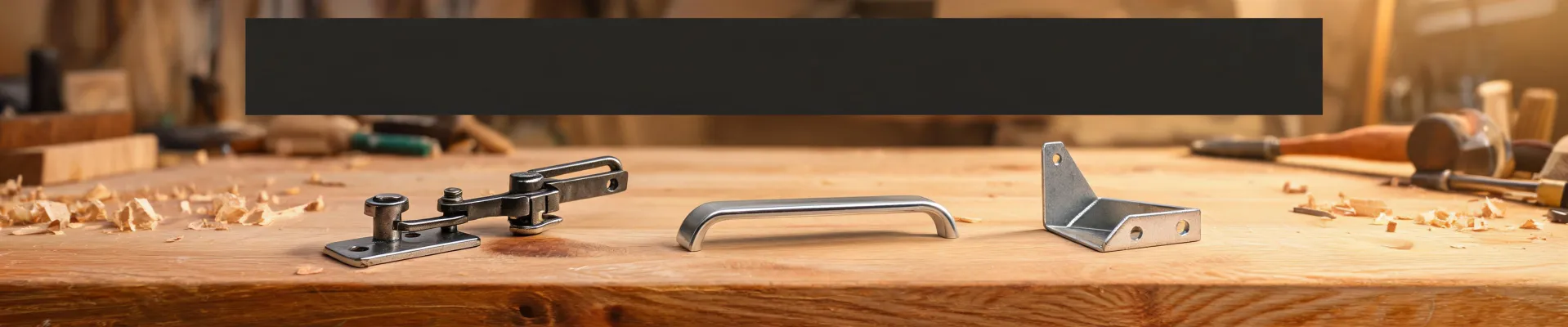
The Emergency-Ready Hardware Kit: What Actually Saves a Job (And What Just Adds Weight)
The Short Answer
If you're building a hardware kit for emergency jobs, spend your money on latches and fasteners before you spend it on tools. Specifically: a National Hardware thumb latch (the N109 050 style), a heavy-duty flip latch, and a properly sized assortment of drywall screws. Everything else—the air tools catalog, the backup impact driver, the third tape measure you swear you'll need—comes second.
Here's why that order matters, and where it breaks down.
Why Latches Beat Tools
I coordinate emergency fulfillment for a mid-size distribution shop. Not the glamorous kind of emergency—the kind where a contractor calls at 6 AM because a gate latch failed on a job site and the client is walking through the property at noon.
In my role triaging rush orders, the pattern is almost always the same: contractors don't get stuck because their tools break. They get stuck because the small hardware failed and they didn't have a replacement on hand.
Last quarter alone, we processed 63 rush orders for latch and fastener components—versus 11 for actual power tools. That ratio tells you something. The failure points in the field aren't the expensive items. They're the $8 hinges and the 50-cent screws.
The National Hardware Thumb Latch (N109 050)
If you've worked with gate hardware, you've probably handled a thumb latch. The National Hardware N109 050 (that's the zinc-plated version, with the thumb lever on the outside and a pull on the inside) is the kind of item that seems small until it's the one thing standing between you and a completed install.
What makes it worth keeping stocked isn't the price—it's the sizing compatibility. It fits standard gate frames and doesn't require a jig or special tooling to install. When you're doing a same-day turnaround, that matters more than whatever minor manufacturing differences exist between brands. (Put another way: a latch you can install in 20 minutes beats a "better" latch that requires 90 minutes and a hole saw.)
Heavy-Duty Flip Latches: When They're Worth It
A heavy-duty flip latch—the National Hardware version is the one I've personally restocked the most—makes sense when the gate sees real load: livestock, vehicle access, or anything that gets cycled more than 30 times a day. On a residential walkway gate, it's overkill. On a commercial driveway gate, it's the difference between a callback and a clean handoff.
The surprise wasn't the durability difference. It was how often contractors under-spec on gates and over-spec on pretty much everything else. People will put a $400 smart lock on a gate that's hung on a bent hinge, then wonder why it drags.
Building Out the Tool Box
"Build out tool box" is one of those search phrases that means different things to different people. For a service tech, it means a rolling chest. For an emergency responder, it means a bag you can grab with one hand.
Here's what I've landed on after testing several configurations:
- Sizing: 16–20 inches. Big enough for a hammer, pry bar, fastener caddy, and a few latch kits. Small enough to carry up a ladder without a second trip.
- Latch section: Two thumb latches (N109 050 or equivalent), one flip latch, one barrel bolt. That's three typical use cases covered.
- Fastener section: Coarse-thread drywall screws in 1-1/4", 1-5/8", and 2"—plus a small container of #8 wood screws. Not the full range. Just the sizes that show up when a job goes sideways.
- Cutting and prying: One 12" pry bar, one utility knife, one oscillating multi-tool with a wood blade. No circular saw. If you need a circular saw, you called the wrong person.
That's it. That's the whole emergency kit. I've gone through three revisions of this list over four years, and each time I've cut something that sounded impressive but never got used.
About That Air Tools Catalog
I'll be honest: I don't understand why "air tools catalog" shows up as a common search alongside basic hardware questions. My best guess is that people are planning a shop setup and researching in the same session as their fastener questions.
But here's the thing—air tools are a shop investment, not an emergency one. If you're doing field work, a cordless impact driver plus the right bits will cover 90% of what an air impact wrench would handle, without the compressor dependency.
Where air tools win: sustained use in a fixed location. Production fastening, repetitive work, anything where the compressor is already running. In those cases, the catalog difference between a 1/2" impact and a 3/8" ratchet matters less than the CFM and the air hose size. That's a topic for a different article.
The Drywall Screw Question (And My $600 Mistake)
"How do I choose the right size drywall screw?" is a question with a clean answer that people still get wrong, because the clean answer assumes you already know the wall thickness.
The rule: match the screw length to the total thickness of the drywall plus at least 5/8" of embedment into the substrate. For 1/2" drywall over 1/2" wood furring, that's a 1-1/4" screw. For 5/8" drywall over wood studs, that's a 1-5/8" screw. Fine thread for steel studs, coarse thread for wood.
That's the textbook answer. Here's what the textbook skips:
In 2023, I cost a client about $600 in rework because I grabbed a box of 1-1/4" coarse-thread screws for what turned out to be 5/8" Type X drywall over steel studs. Wrong thread, wrong length. The screws chewed through the paper without embedding properly, and we had a whole wall of screw heads popping through the finish. Ugh.
What I learned: always check the drywall thickness before you reach for the fastener bin. And if you're not sure, buy twice as many of the two most likely sizes and return the ones you don't use. The restock fee is cheaper than the rework.
When This Approach Doesn't Work
I can only speak to domestic, small-to-mid-size commercial and residential work. If you're doing high-rise construction or industrial gates, the calculus is different—you'll need engineered hardware and documented load ratings, not a grab bag.
And if you're a distributor deciding what to stock for other contractors, don't copy my emergency kit list. Stock what moves. The latches and screws in this article are common because they're failure points, not because they're the highest-margin items in the catalog.
That said—if National Hardware's distribution pattern tells you anything, it's that the boring items keep the doors open. Nobody ever called me in a panic because they were out of impact drivers. They call because they're out of the one $4 hinge that the whole gate depends on.
Plan accordingly.

Koji Sakamoto
Koji Sakamoto is an independent pneumatic tool and compressor analyst covering air compressors, impact wrenches, air ratchets, nail guns, and general air-tool systems. He applies ISO 11148 safety requirements while evaluating working pressure, free-air delivery, air consumption, hose loss, duty cycle, fastener capacity, vibration, noise, lubrication, and moisture control. His application guides help workshops and contractors size air supplies, compare tool output, and prevent performance losses caused by undersized or poorly maintained systems.