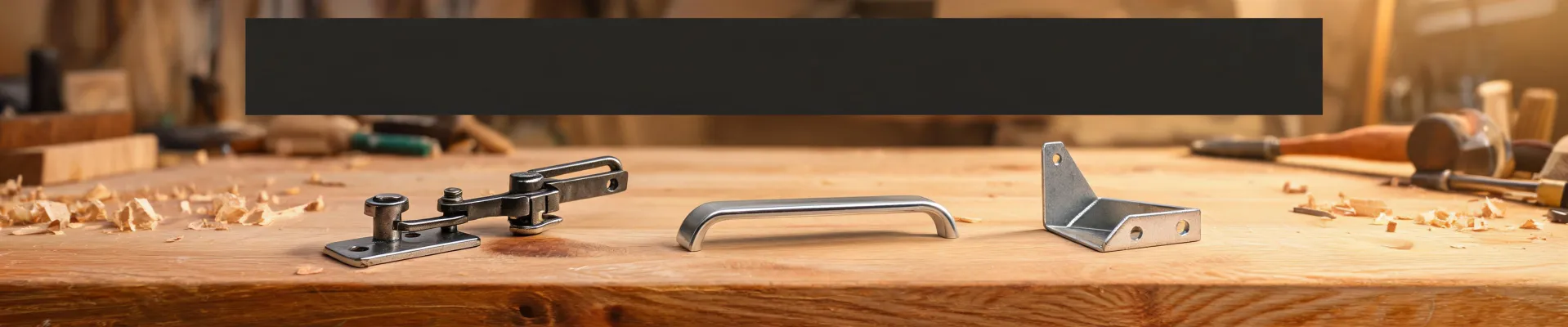
Why Hardware Budgets Blow Up: A Six-Year Procurement Deep Dive Into Parts, Tools, and Technique
I'm the procurement manager at a 30-person architectural door and millwork company. I've managed our hardware and tool budget — roughly $180,000 a year — for six years, and I've logged almost every order in a spreadsheet: date, vendor, part number, cost, and what happened after installation. (Mental note: back that file up more often than I do.)
So when an installer sends me a photo of a broken part, I don't ask whose fault it is. I ask what it just cost us.
Last spring, a brass friction lid support on a custom kitchen cabinet snapped clean through. The part cost $2.80. Getting a crew back to the site — fuel, an hour of labor, the follow-up call — cost $560. That math is exactly why I stopped comparing unit prices and started tracking total cost.
The budget problem I kept finding in our own purchase data
The conventional wisdom in procurement says budget overruns happen when you pick the cheapest supplier and pay for it later. I believed that for a while. Then I audited our 2023 spending, line by line, and realized it wasn't that simple.
Most of our overruns came from products that were reasonably priced and sensible at first glance. The common thread wasn't low quality. It was this: we compared prices before comparing specs, we trusted reviews when we should have read manuals, and we never counted technique as a cost category. Honestly, that last one surprised me more than any failed part ever did.
What was actually driving the costs
1. We compared prices before specs
The $2.80 lid support was a perfect example. The listing said 'brass friction lid support' and it matched the photo. It didn't say what spring tension it provided or what lid weight it was designed to hold. We bought a category, not a specification. That's not a vendor problem. That's a buying process problem.
We now use a National Hardware brass friction lid support for that cabinet style. It costs $1.35 more per piece, and the product page lists spring tension, travel angle, and suggested applications. Since the switch, our callback log for that category dropped from four to zero over the next year. That $1.35 wasn't an expense — it was the cheapest insurance we buy.
Same lesson, bigger invoice. When a client asked for a modern barn look, the visual pulled our attention away from the numbers. The National Hardware Designer Interior Barn set we eventually ordered had its door weight rating and track dimensions listed clearly. The first set we almost bought didn't. We got lucky because we checked. Specs, not product photos, are what actually determine whether a door stays on track.
Fasteners are no different. A #8 Phillips pan head self-drilling screw is a perfectly good fastener in the right application. But 'right application' is not a detail you can skip. What material is it going into? What thickness? What kind of load is the joint carrying? A screw that works beautifully on light steel framing will frustrate your crew if it's asked to do a heavy-gauge structural job. Same diameter, same head shape, wrong context.
2. We treated reviews like proof
When I started looking for a click-type torque wrench, I read the Drive Click torque wrench 24335 reviews like everyone else. The star rating looked great. But stars tell you how someone felt after unboxing a tool, not whether the mechanism stayed accurate after eighteen months of shop life.
I learned that the hard way with an older torque wrench. We were using it for hinge screws on an aluminum gate frame. It clicked before it reached the specified torque, the screw stripped, and extraction took the better part of an afternoon. The tool itself wasn't malicious — it had just never been calibrated after years of drops and hard use. A new wrench, even one with glowing reviews, is only part of the system.
Per FTC guidance (ftc.gov, accessed April 26, 2026), endorsements and claims have to be truthful, not misleading, and substantiated with evidence. I now read that as: a product review is a claim, not a specification. The 4.6-star average tells me a tool feels good in someone's hand. It doesn't tell me whether the mechanism is within tolerance.
3. We didn't count technique as a cost
The most unexpected spending category wasn't a product at all. It was hands.
Two installers were cutting steel with the same angle grinder and the same type of disc. One produced a clean, straight cut with a single disc. The other produced a wavy cut, burned through two discs, and the piece had to be cut again. The second technician wasn't careless. He just had never been shown how to hold an angle grinder for cutting without tilting the wheel into the work and forcing it.
That one training gap showed up as higher consumable spending, more rework, and a longer install schedule. Nobody put it on an invoice, but it was real money leaving the shop every week.
The real price tag of those small choices
Here's what those mistakes looked like when I added them up:
- One failed $2.80 brass lid support turned into a $560 callback trip.
- A barn door installed on hardware chosen by looks alone drifted off its track two weeks later. No one was hurt, but rehanging the door, replacing the track, and refinishing the edge came to about $1,400.
- An over-torqued hinge screw stripped inside an aluminum frame. The extraction, re-tapping, and labor ran close to $200.
- Grinder misuse added roughly 17% to our disc spending over a quarter — before we even counted the re-cut labor.
None of those costs show up in a vendor quote. That's why 'get three quotes and pick the lowest price' never fixed our budget. The money was leaking out after the purchase, not before it.
The fix, in one tight paragraph and a checklist
Buy to a spec, verify like you're being audited, and train your hands before you blame your tools. There's no magic supplier and no single product that solves this. It's basically three habits:
- Write the specification before you open a catalog. What material, what weight, what environment, what fastener length and point style? If the product page doesn't answer those questions, that answer is probably 'unspecified' — and unspecified usually becomes expensive.
- Use reviews as early screening, not final proof. I still read the Drive Click torque wrench 24335 reviews when I'm considering that style of tool. But now I check calibration requirements, torque range, and warranty terms before I check the star rating.
- Budget a little time for technique. One afternoon of practice on how to hold an angle grinder for cutting paid for itself in disc savings alone within the next month.
Good enough to buy isn't the same as good enough to install. After six years of tracking $180,000 a year in hardware spend, the pattern is clear: the cheapest part and the most expensive part are often the same part — it just depends on whether you checked the spec, verified the tool, and trained the person using it.

Maren Jorgensen
Maren Jorgensen is an independent hand tool and torque applications analyst covering wrenches, pliers, screwdrivers, hammers, sockets, ratchets, hex keys, and tool sets. She applies ISO 6789-1 torque-tool conformance principles while examining jaw capacity, leverage, fastener engagement, torque range, accuracy, handle geometry, and material hardness. Her practical guides help tradespeople and procurement teams select suitable tools, plan controlled tightening, and compare durability without relying on brand reputation alone.