I Trusted the Stock Report Over My Gut — It Cost $610 and a Contractor's Week
It was a Friday morning in March 2025, still cold enough that frost hadn't burned off the truck windshields on the loading dock. A contractor we'd worked with for years called in a rush order: 12 National Hardware sliding door closers, two dozen lockable draw catches (SKU N208-603), a pull-behind air compressor for a fence job, and a rail and stile router bit set. He wanted it staged by 2 p.m., and if you've handled B2B hardware orders for long, you know how a promise like that is gonna get tested.
Context on me, because this story is about how habits beat intentions: I've been handling B2B hardware orders for eight years, six of them here at National Hardware. I've personally made—and documented—32 significant mistakes in that time, totaling roughly $18,000 in wasted budget. I'm the person on our team who maintains the pre-shipment checklist. This mistake is one of the reasons the checklist exists.
In my first year, 2017, I made the classic blunder: I shipped boxed hinges based on the box label alone, and half those boxes were factory re-labels with the wrong hinge inside. That one cost us a $2,100 chargeback and a very red face. You'd think that would have cured me permanently. Turns out it didn't, because the March 2025 mistake was the same class of error wearing a different costume.
The order that felt routine
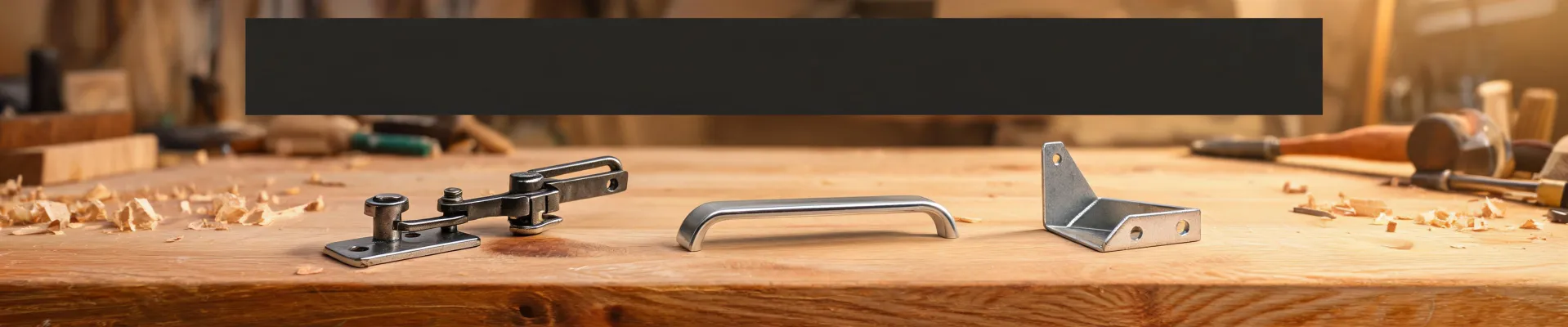
The draw catches were the problem child. N208-603 is the locking version of National Hardware's draw catch. It shares a body, a strike plate, and a finish with the non-locking version; the only visible difference is a small key cylinder in the center of the catch. You can hold one of these, decide you've seen it before, and walk away—because visually, you have.
The inventory report said 24 in stock at location B-14. The pick ticket was clean. My gut, though, gave me one of those flickers you learn to recognize after year three: the drawer had felt light when I walked past it two days earlier, and the picker, Dana, asked, 'These are the ones with the key, right?' I said yes—the system said so—without walking over and pulling the drawer. No, wait, that's not entirely fair: I did glance at the bin from the aisle. I didn't open the tray. The numbers pointed to B-14, so I went with the numbers.
(Should mention: a temp had consolidated the returns shelf that week, and I knew it and didn't adjust. That detail is doing the heavy lifting later.)
The rest of the line went out clean. On the sliding door closers, I asked the obvious question—hold-open arm or not—because the N-series catalogs two different closers, and 'standard close' doesn't mean the same thing from one product line to another. If 'sliding door close' is the phrase you searched to land here, this is the product you mean: the closer that pulls a sliding door shut automatically, not the track and not the strike. The rail and stile router bits went out as a matched pair, which is the only way they make sense: the rail bit cuts the tongue, the stile bit cuts the matching groove, and running one without the other is how you get cabinet doors that lean like a bad fence. And the pull-behind air compressor left the dock with the right hitch, because I checked the ball size before I promised anything.
That afternoon, the contractor's foreman called with a question we get weekly: 'Are circular saw blades reverse threaded?' He'd borrowed an angle grinder over the weekend and assumed the saw worked the same way. 'No,' I said. 'Not on circular saws. That's angle grinders.' I gave him the short version: most circular saw blades use a standard right-hand arbor nut, so you loosen it counter-clockwise when you're facing the blade side, with the spindle lock engaged. Angle grinders are the reverse-threaded oddballs; the left-hand thread is deliberate, so rotation tightens the nut instead of loosening it. He thanked me, and I went home feeling genuinely useful. Which is exactly when things got interesting.
The phone call I was hoping not to get
Tuesday morning, the contractor called. I could hear the job site behind him. 'These draw catches you sent—they're not the locking ones.'
I pulled the order up. It said N208-603, locking, quantity 24. 'They should be,' I said. 'There's no key slot, man. These are plain.' I walked to the aisle with the phone still at my ear. The bin was labeled N208-603. I pulled the tray out anyway—partly procedure, mostly because I was losing confidence—and there they were: a jumble of both draw catches, same finish, same size, one with a small key cylinder and one without. The temp's consolidation had taken returned units off the returns shelf and dropped them into the wrong bin, and I had confirmed the pick without looking at a single part.
Here's the part where I'm supposed to say the mistake nearly sank us. It didn't. It cost about $610. Actually, $660, when you count the hour I spent reconciling the tray and the reprint of the pick ticket. We ate the two-way freight on the wrong units and paid for overnight on the right ones. The bigger bill was time: the contractor's crew lost five days waiting, and the fence line had to be re-sequenced around the delay. I lost a little credibility too, which is the one currency in this industry you can't move to a different drawer.
I have mixed feelings about that number. Part of me is relieved it wasn't worse. Another part is annoyed that it wasn't zero, because zero was available at the price of thirty seconds and an open drawer.
What the checklist says now
The lesson wasn't 'the temp messed up.' The temp did mess up. But I'm the one who confirmed a pick without verifying the part. The stock report was right. The bin label was right. The actual hardware was wrong—which is exactly the gap a system can't see. An inventory system only knows what got entered. It doesn't know what's physically in the drawer.
So we added a rule to our shipping checklist: two-label verification for any SKU that has a look-alike twin. Check the bin label, check the stamp on the part, and if they don't match, stop. That's the whole rule. It sounds embarrassingly simple, and it has caught 41 potential errors in the 13 months since. I'm not going to pretend it's clever. It's just the rule that covers the mistake I actually made.
Draw catches: the lockable twin problem
If you're ordering a lockable draw catch and the part number rings a bell, double-check it. We see searches for 'N208-603' every week, and a surprising share of those customers don't realize it has a non-locking twin. If a lock matters—toolbox, gate, a cabinet that's going to face an inspection—make sure the word 'locking' is on the order and the part actually has the key cylinder. And if you're returning hardware, read the SKU off the box rather than saying 'it's the one on the left.' A good portion of returns mix-ups start that way. There's a standards layer beneath all this too; ANSI/BHMA publishes performance grades for builders' hardware, and the locking function of a catch is exactly the kind of spec you don't want to infer from a product photo.
Circular saw blade threads: the short answer
Since it came up that day: no, circular saw blades are not reverse threaded. The arbor nut on nearly every circular saw is standard right-hand. Engage the spindle lock and turn the wrench counter-clockwise when facing the blade side. Angle grinders are reverse-threaded, and that's by design—a left-hand thread tightens as the rotation spins. If your saw's manual contradicts any of this, trust the manual, because a few tools do things differently, and a stripped arbor is a steep price for internet confidence.
The parts that went right (and why)
The sliding door closers shipped correctly because we asked about the hold-open arm. The rail and stile router bits shipped as a set because we don't offer them separately without a warning. The pull-behind air compressor shipped with the right hitch because we checked before promising. None of that was heroic. They were 30-second questions that kept half the order from becoming a problem. The 30 seconds I didn't spend on the draw catches was the only difference between a Monday delivery and a Tuesday apology.
The inventory system knows what you entered. It doesn't know what's in the drawer. When the two disagree, the drawer always wins the argument—but only if you actually look inside it.
I still occasionally wonder whether the two-label rule is overkill. Part of me thinks it is; most days, no look-alike trap is anywhere near the order. The other part remembers the sound of a contractor's voice when the part is wrong, and keeps the rule. If you're buying for a crew, spend the extra minute: confirm the locking feature on the catch, the thread direction on the blade, and the hitch size on the compressor. An informed customer asks better questions, and better questions catch the mistake before it ships instead of after.

Maren Jorgensen
Maren Jorgensen is an independent hand tool and torque applications analyst covering wrenches, pliers, screwdrivers, hammers, sockets, ratchets, hex keys, and tool sets. She applies ISO 6789-1 torque-tool conformance principles while examining jaw capacity, leverage, fastener engagement, torque range, accuracy, handle geometry, and material hardness. Her practical guides help tradespeople and procurement teams select suitable tools, plan controlled tightening, and compare durability without relying on brand reputation alone.