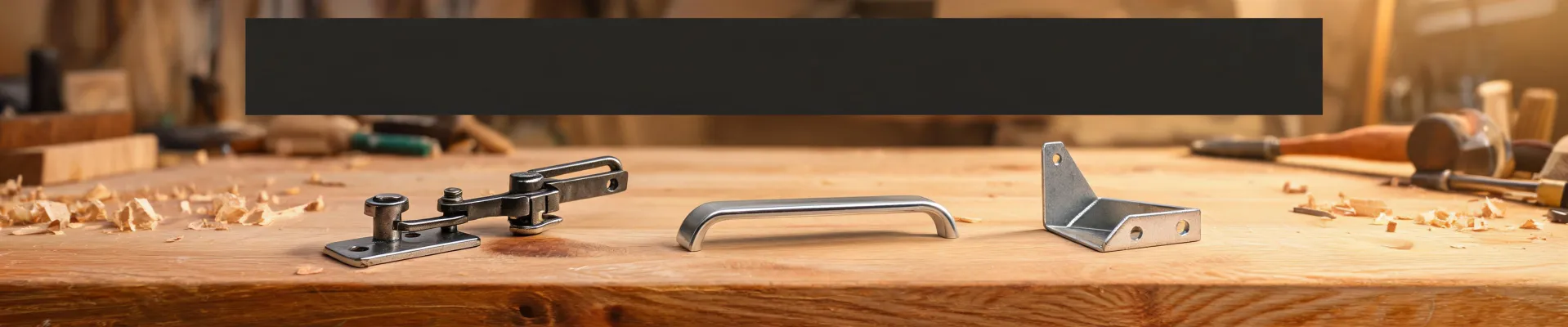
National Hardware Products Don't Cause Reorders—Vague Orders Do
Here's an opinion that might annoy some suppliers: most wasted money in hardware ordering doesn't come from the product. It comes from buying too early and specifying too late. A wrong order doesn't just cost the list price. It costs return freight, a rush reorder, lost crew time, and one more conversation with a customer who didn't cause the problem.
I'm a purchasing manager for a contracting crew that does gate and fence work around the Southeast. I've been handling hardware orders for 11 years, and I've personally made—and documented—14 significant ordering mistakes, totaling roughly $11,000 in wasted budget. Now I maintain our team's pre-order checklist, but that checklist only exists because I paid for the lessons.
Here's the thing: efficiency isn't a faster checkout. It's the boring thirty seconds before you enter the card number. The more details you include—gate width, post material, material thickness, thread size, lift height—the less your supplier has to guess. And the fewer times that purchase order comes back.
The First Mistake Was Hanger Screws. The Real Mistake Was Hope.
If you type “hanger screws” into a search bar, you'll see page after page of options that look basically the same. That's why “we need hanger screws” is not enough. In fall 2022, on a gate rebuild in Columbia, South Carolina, I needed to attach a wood gate panel to a steel post. The fastener was definitely hanger screws. The diameter? The thread pitch? The length of the machine-thread end? No idea. I knew I should check, but the job was already two days behind, and I told myself “what are the odds?”
The odds caught up with us in a customer's driveway. The crew unboxed the order, tried to fit the nuts, and nothing matched. Fifty fasteners, plus a rush reorder, plus a return label—that little moment of hope set us back roughly $214 and two calendar days. I didn't buy the wrong product category. I bought a description instead of a spec.
A 1 1/2 Ton Chain Hoist Is a Load Rating, Not a Job Plan
Chain hoists taught me the same lesson with higher stakes. In January 2026, one of our crews asked for a 1 1/2 ton chain hoist to lift a steel gate beam into place. The request sounded complete. It wasn't. I went back and forth between two models: the one I'd normally buy and a less expensive unit that saved us about $82. The numbers said the cheaper model met the load rating, so I ordered it. My gut said to check the lift height before paying. I didn't.
The hoist showed up with a 10-foot lift. Our mounting point was 16 feet above the slab. The hook couldn't drop low enough to pick up the beam from the ground. No one was hurt—we caught it before rigging anything—but the tool was useless for the task. The $82 I'd saved turned into about $340 in freight and an entire crew with nothing to do for half a day. Put another way: I let one rating replace the whole spec sheet.
“What Drill Bit Is Needed for Stainless Steel?” Is the Right Question, Asked Too Late
Ask around our shop, and someone will eventually say, “what drill bit is needed for stainless steel?” It's the right question to ask, but it's not the first one. I learned that in December 2023, when we were mounting hinges on a stainless steel gate. I looked up the bit style, bought it, and handed it to the crew. Fifteen minutes later, the bit was smoking. Why? Because the bit was right and the plan wasn't. I hadn't thought about the steel thickness or the speed we'd use, and nobody had cutting fluid on-site. A one-line question got a one-line answer, and a one-line answer doesn't make a hole in stainless steel.
The working version of that question has more parts: What's the material grade? How thick is it? What size hole do we actually need? Which drill motor is driving the bit? That's also the difference between ordering hardware and ordering the right hardware.
But Shouldn't a Good Supplier Ask?
Here's the pushback I expect: “A good supplier should know to ask these things.” I used to say the same thing, and I've been saved by good reps more than once. The National Hardware location in Florence, SC, has talked me out of a couple of bad ideas without making me feel dumb about it. But they could only do that because I eventually gave them real information. If someone calls and says “I need the National Hardware rustic modern gate kit,” that gets you to a catalog page, not necessarily to the right box. Gate width, post material, and finish—that's what makes the catalog page useful. You can have a great supplier and still send them a guess; those two things are true at the same time.
Look, I'm not saying you should never ask a supplier for advice. I'm saying make it easy for that advice to work. When you ask what drill bit is needed for stainless steel, include the steel thickness and the hole size. When you ask for hanger screws, include the thread size. When you need a 1 1/2 ton chain hoist, include the required lift height. A small amount of friction at the start removes a ton of friction later. The most efficient order is the one that doesn't come back.
That's the opinion I carry from 11 years of buying hardware and 14 expensive lessons: product names are the start, not the end. A National Hardware order is only as good as the information behind it. Brand fixes the search result. Specifications fix the installation.

Maren Jorgensen
Maren Jorgensen is an independent hand tool and torque applications analyst covering wrenches, pliers, screwdrivers, hammers, sockets, ratchets, hex keys, and tool sets. She applies ISO 6789-1 torque-tool conformance principles while examining jaw capacity, leverage, fastener engagement, torque range, accuracy, handle geometry, and material hardness. Her practical guides help tradespeople and procurement teams select suitable tools, plan controlled tightening, and compare durability without relying on brand reputation alone.